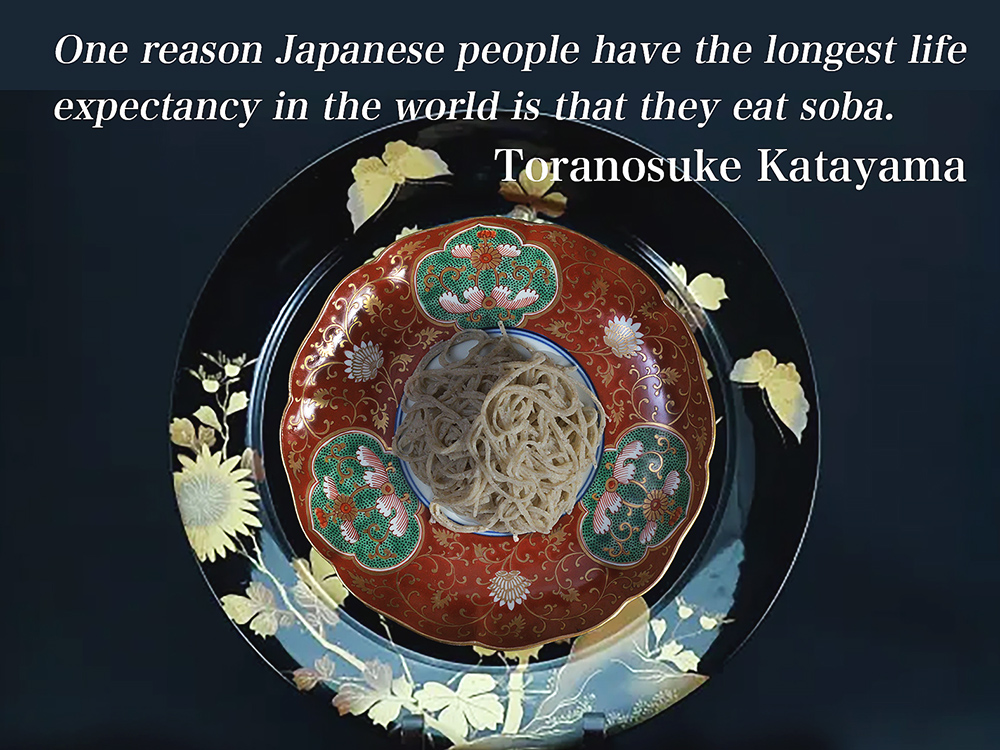
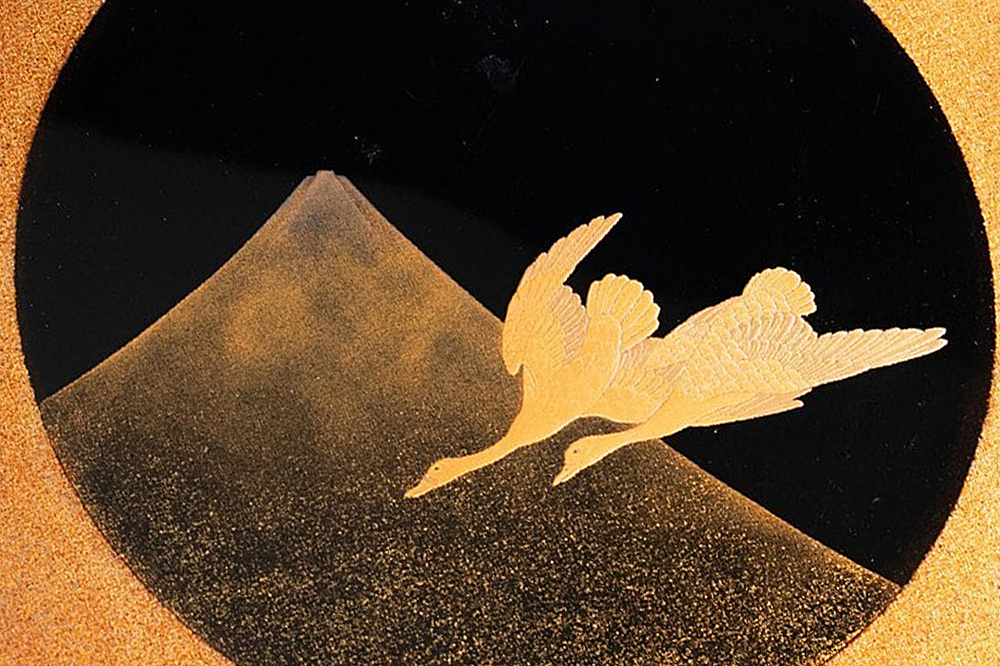
⬇︎At the soba workshop held by Toranosuke Katayama in Kyoto, participants enjoy their soba served in antique vessels dating back over a century. These vessels feature a *makie* (sprinkled gold/silver powder) lacquer design depicting Mount Fuji alongside migrating wild geese—a combination considered highly auspicious. Mount Fuji symbolizes a sacred peak and eternal life, while wild geese herald the arrival of autumn; their habit of flying in flocks serves as a metaphor for bonds between people and the arrival of good news or welcome guests.
We are hosting a special workshop where you can experience soba as it was made in Japan 350 years ago. / Toranosuke Katayama
At its core, Japanese soba is a dish made from nothing more than buckwheat flour and water. Despite the simplicity of these ingredients, soba offers countless variations, resulting in a virtually infinite range of flavors.
How, then, should one truly savor this unique and intriguing food?
I would like to discuss the distinctive and mysterious ways in which soba is eaten and enjoyed—practices truly unparalleled anywhere else in the world.
Please take a look at the photo below.
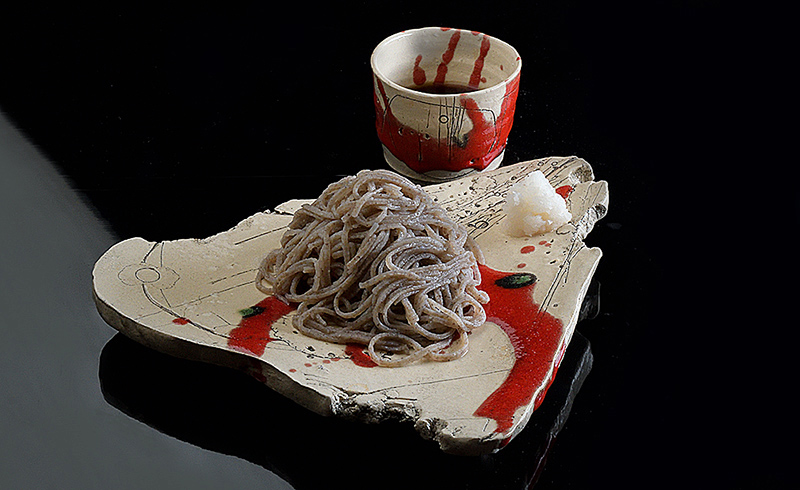
This is a soba dish called “Van Gogh’s Ni-hachi Soba,” which I, Toranosuke Katayama, unveiled in 2022.
I—Katayama—conceived this soba after seeing the original paintings Van Gogh created during his Arles period and being deeply moved by their brilliance; I thought to myself, “I want to create a soba that embodies the spirit of these paintings.”
As for what makes it “Van Gogh-esque”: I felt that the works from his Arles period marked a radical departure from his previous style—they were clear and high-contrast, possessing a compelling quality that felt deeply satisfying, yet they also harbored a passion bordering on madness.
Determined to craft a soba with that same captivating allure, I cast aside all the conventional wisdom about soba-making I had previously held and built up the necessary techniques from scratch—starting with a blank slate—to achieve my goal.
“Van Gogh’s Ni-hachi Soba” is the result of extensive trial and error.
It possesses a flavor profile that is clear and sharply defined, offering a satisfyingly persuasive quality while harboring an intense passion.
This soba overturns all conventional wisdom regarding the dish. In a world where the prevailing view is that “soba isn’t soba unless the strands remain long and unbroken,” we crafted this noodle to celebrate the very act of breaking. Within a single 1.4mm-thick strand, we have harmonized elements that hold together with those that break apart; you can savor the continuity of the noodle while simultaneously enjoying the texture of it snapping.
“Van Gogh’s Ni-hachi Soba” is no ordinary soba. We aimed to create a noodle that serves as a form of self-expression—a work of art.
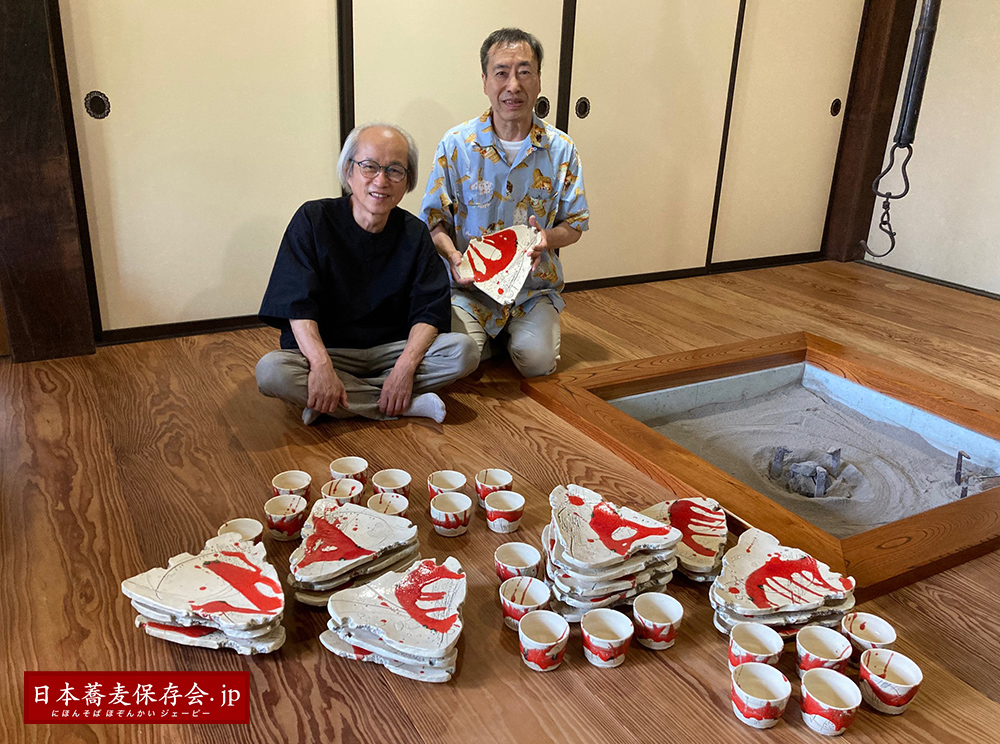
The vessel used to serve “Van Gogh’s Ni-hachi Soba” was created by ceramic artist Kazu Yamada—whose works are held in the collection of the Victoria and Albert Museum in the UK—after he fell in love with the soba itself. Named the “Red-Glazed Oribe Soba Plate,” this dish—along with the noodles and their flavor—comes together to form the artistic world of “Van Gogh’s Ni-hachi Soba.”
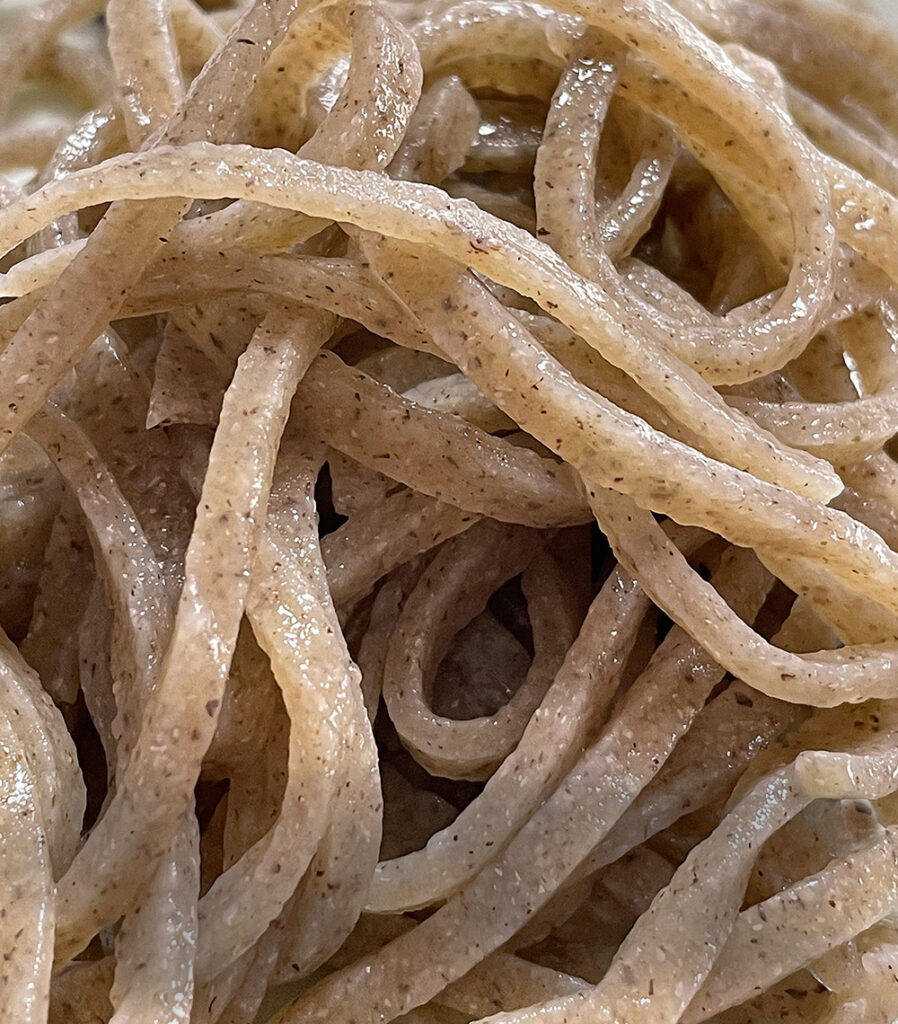
This soba possesses a unique texture, flavor, and aroma—distinctly different from the “ordinary soba” sold in town shops. Its appearance is unique, too: the noodle surface is textured and beautifully translucent, speckled with the dark dots known as “stars.”
Soba is a rare dish where you can gauge its flavor simply by looking at it.
The textured surface hints at a pleasant mouthfeel, while the noodles’ sharp, square-cut edges—known as *kado ga tatta soba* (soba with distinct, crisp edges)—promise a satisfying sensation as they slide down the throat. The translucency suggests a clean, refreshing finish, and the dark “stars” promise the rich, authentic flavor characteristic of buckwheat.
Anyone who truly appreciates soba would find their mouth watering at the mere sight of this photograph. That is precisely why Mr. Kazu Yamada—an artist who loves both soba and Van Gogh—readily agreed to craft the serving vessel after seeing the picture.
⬇︎ Kazu Yamada and Toranosuke Katayama when the “Van Gogh’s Ni-hachi Soba” plate was completed.
Toranosuke Katayama has revived the most authentic style of Japanese soba—a tradition that had otherwise faded away.
We are hosting a special workshop in Kyoto where participants can learn to hand-craft and enjoy this “true” Japanese soba—a version entirely distinct from what is typically served in modern soba restaurants.
Toranosuke Katayama himself will provide direct, hands-on instruction.
The workshop will be held in a unique, culturally significant venue—a site generally closed to the public—and will be scheduled specifically to accommodate the participants.
You will enjoy a Japanese-style multi-course meal centered around a type of soba (buckwheat noodle) from 350 years ago—a taste that can no longer be experienced today.
As this session is held exclusively for those who have signed up, you will be able to fully savor the delights of Japanese cuisine within a serene and beautiful setting.
Due to various associated costs—including the involvement of top-tier culinary professionals—the tuition fee for this course is substantial.
Nevertheless, if you wish to embark on this journey toward the truth—a voyage akin to time travel—please click the image below to get in touch. We will make arrangements to suit your schedule.
As this is an exceptionally unique event, distinct from standard courses, please be sure to explicitly state, “I would like to sign up for Toranosuke Katayama’s special Kyoto course,” when you submit your application.
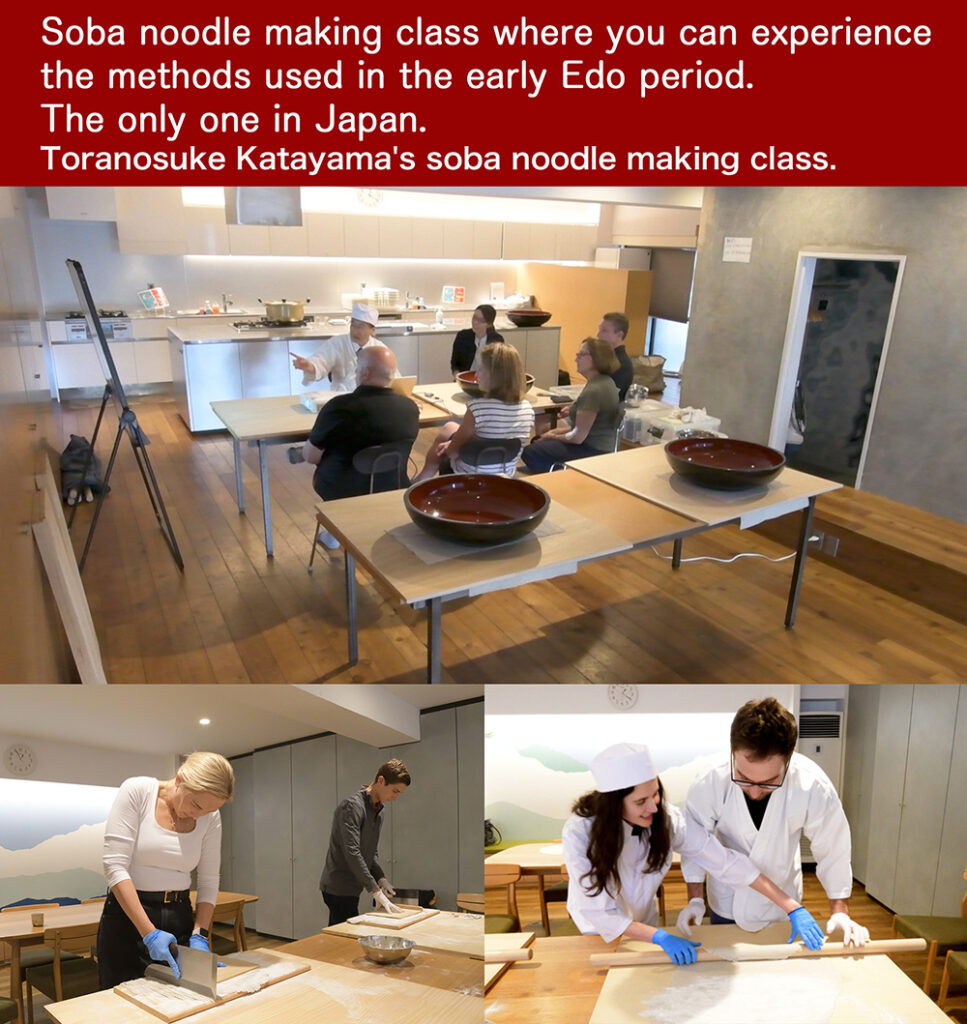
⬇︎ Please proceed here to register. The photos below show our regular workshops held in Tokyo. The special workshop featured on this site takes place exclusively in Kyoto, and will be hosted within a historic building designated as a cultural property. When registering, please be sure to specify that you wish to participate in “Toranosuke Katayama’s Kyoto Workshop.”

⬇︎ This site is currently under construction. In the meantime, please click on the photo here to visit our “Soba Knowledge” website.